Love is one of my favorite topics. Especially love as it plays out in society. Since it’s something I speak about and highlight often, even without provocation, I’ve decided to write more about it this year.
Love is a broad idea, so I’ve been brainstorming ways to approach it in meaningful slices. Given my professional background, it seems a good place to start would be schools as sites of love (or not). With my concurrent interests in prison abolition, the school to prison pipeline, and restorative justice, love is perhaps a natural lens through which to consider those intersections.
To that end, I’d like to share this piece from yesterday’s Washington Post. School leaders in Alexandria agreed to implement a restorative justice program this school year. The school year is halfway over, and the program has yet to begin. Students are upset. They believe school is a place of learning.
“I think school can be a place where you learn from your mistakes,” said Ana Diaz, 16, a junior at T.C. Williams. “We should be taught how to be a better person and how to do things better. [It should not be] a place where you did something wrong and so you got kicked out.”
Restorative programs focus on healing and repairing harm done. They provide an opportunity for all involved in a given incident – the offender, the victim and the community – to participate in justice. Everyone can learn. Everyone can grow. This premise, that students and teachers are human and may benefit from healing rather than payback or vengeance, is loving.
Such approaches are not quick fixes. They are not “off-the-shelf” programs one can just disseminate in a school. They do require research and professional development. According to officials, this is the cause of the delay this year:
Kelly Alexander, a spokeswoman for Alexandria schools, said officials agree with the principles of restorative justice and are committed to introducing it at the high school. “We are attempting to gather good information before we take the next steps,” she said.
Today’s run surprised me. It had been over a week since my last 4-mile run. Generally speaking, a couple of rest days are good for me. But too many means I start to lose a level of fitness.
It’s not to say I forewent exercise completely. In addition to rest days, I had a couple of bouts of weather-induced indoor aerobics. I also threw two short runs in the mix. In a hotel and pressed for time two mornings in a row, the treadmill beckoned. I’ve mentioned more than once how much I enjoy outdoor running and dislike treadmills, but there was no safe place to run nearby. It was the ‘mill or nothing.
No Bueno
Let’s get right to it and say both of those runs sucked. I never felt as though I could get a good breathing rhythm. I never locked into an ideal stride. I just wasn’t comfortable. Both days, two miles of running felt like five or six miles worth of work.
The past couple of mornings, I looked forward to getting back outside. Yesterday, was a disappointment. Mild fall temps were on my side, but the pouring rain was not. I decided to get on with the remainder of my day, foregoing exercise altogether.
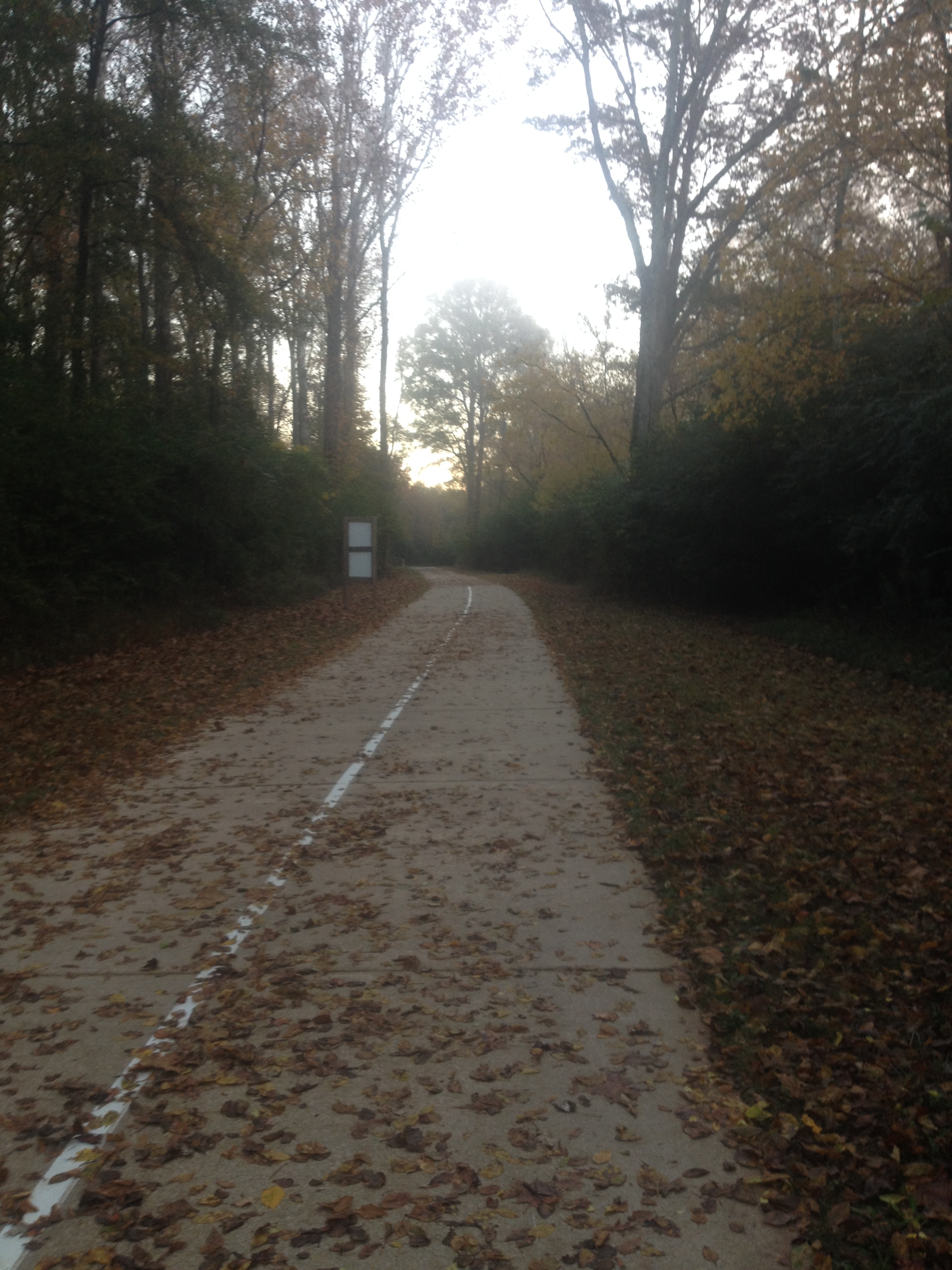
The Greenway this morning.
Doubting Thomasina
Today, it was cooler than ideal, but clear, and I was determined to go get my miles. But get this: I was worried. Because my recent runs were short and difficult, I wondered if I had what it took to eek out my mileage. Some Saturdays I toy with the idea of a “long run” (five miles or more), but today my standard four felt like a stretch.
I wondered just how long it would take me to finish. How would I feel at the halfway point? Would I have to walk it out for large stretches of the trail? Would I just stop at a mile and turn around? The questions loomed. This level of uncertainty about a run is unusual for me, but there it was. I stalled a bit, and went out anyway.
When I got to the Greenway, I could tell immediately the run was going to go well after all. I easily hit my warm up pace and found a comfortable stride within the first 1/2 mile. It felt nice to open up and push the tempo. Being outdoors again was glorious, despite the cool air. Despite the damp leaves clinging to the trail.
I felt great, like the in shape runner I am.
Getting up to Snuff
I’ve run intervals a few times this year. Before now, I’d never tried them out. It’s true they help with speed, and I’ve come to realize they build my confidence as well. I know I’m reasonably fast for super short distances – I was a sprinter in my day. A few years at 3+ miles per run, I’ve now built some endurance, but often I’m scared to push my pace. I simply don’t want to peter out.
But intervals are designed for you to push, then rest. And really, I’m not racing anyone. I’m building my own fitness. Who cares if I need to rest at various points during my run anyway, intervals or not? And just because I got comfortable holding a steady pace at four miles, didn’t mean I needed to remain comfortable. That can easily lead to stagnation. And to some degree, it had.
Movie Lessons
In recent runs, I’ve found myself thinking about all of this while also mulling a scene from Gattaca (spoiler alert). In it, brothers Anton and Vincent are swimming. Ever since they were children, they tested each other to see who had the endurance to swim the farthest in open waters. Anton always won.
An older wiser Vincent finally stopped living down to everyone else’s expectations, and resolved to give life his all. In a confrontation between the two, they decide to swim one last time. Right when Vincent would’ve cried mercy, he didn’t. This time, Anton was the one who tapped out. He screamed at Vincent demanding to know how he was accomplishing this. How was he pushing beyond well-established boundaries? Said Vincent,
I never saved anything for the swim back.
Vincent gave it his all. He held nothing back. He learned to overcome his limiting beliefs about himself. In the end, he was victorious.
Holding Back
Often, I hold back when running. I get comfortable with a certain pace. Knowing I can push it, but will have to recover later, I don’t take chances. Steady state. But with the introduction of intervals, I saw my fitness increasing, and it became easier for me to see what would happen if I push it. I’d go faster! And yes, I may have to rest a bit, but I’d go faster for longer the next time.
So today, out on the open path, no music, no pressure, just me, I ran. And when it felt good, I ran faster. And when I thought I’d been running a good distance at a good pace, I checked in. Do I really need to rest right now, or am I holding back? And I’d rest or run accordingly.
It was a great run. Much faster than usual the first two miles, and faster in stretches toward the end. I ran my fastest overall pace for this distance.
I surprised myself. I didn’t hold back. The race was only with myself, and I won.
Late last month, I checked email to find this subject line topping my inbox. I’ve known Marla, a slim, vibrant beauty from Chicago, since college. She’s always been stylish in her size zero clothes, a graceful stride in striking heels or casual kicks. Perhaps it’s the dancer in her, she’s regal, shoulders back, long neck, even when frowning about some injustice. Whether in locks or a full ‘fro, her hairdo compliments her warm countenance.
Marla (left) & me at Dina’s wedding, 2011.
From the mid-90s until two years ago when we saw each other at a soror’s wedding, this was my enduring image of her. In 2011, she hadn’t changed a bit. And even though her life is dramatically different now in 2013, much about her is still the same.
At 38 she is still warm, she is still vibrant, and now she is living with lupus.
Marla agreed to share a bit about her story, as there are still many people who know little to nothing about lupus. Rather than summarize or paraphrase, I’m using Marla’s own words here (quoted and in red). It’s her story, after all. I want her to tell it.
I began by asking her to define lupus:
Our immune system is supposed to create antibodies that protect our bodies from viruses, bacteria, germs, etc. Lupus is an autoimmune disease. This means that my immune system can’t tell the difference between the bad stuff and the good stuff. So it creates antibodies that also attack and destroy healthy tissue. Lupus can affect the skin, joints and damage major organs (kidneys, heart, lungs) by causing inflammation and pain.
It’s somewhat simple to describe what lupus is, but discovering you actually have it is another matter entirely. In 2012, I remembered receiving a text from Tavares, a mutual friend of ours. Marla had been in the hospital for days by then, but no one could say why. I ventured a phone call to see if she was up for a quick hello. Her voice was weak – practically a whisper. It was disconcerting to hear her that way. Ages passed before doctors put the pieces together and made the diagnosis. Marla describes this period as the scariest time of her life:
It was early January 2012, I got sick with what I thought was the stomach flu. I was having really bad stomach pains, fever, fatigue. This lasted for about four days with no reprieve. After the fourth day, I started to have chest pains and difficulty breathing. It was at that time that I decided to go to the ER.
I was seriously dehydrated because I hadn’t eaten anything during those four days. My blood pressure was really low and my heart rate was really high. They ended up giving my about 19 liters of fluid and I gained 20 pounds from that alone. I was first in the ICU (Intensive Care Unit) for about two days. They found out nothing was wrong with my heart, so I was sent to the regular area. Over the next 11 days, I was tested for everything under the sun. I had biopsies on my skin and lymph nodes. I had innumerable CT scans and x-rays. I had a colonoscopy. They could not figure out what was wrong.
Looking back, I can see that things were happening that I didn’t see as symptoms, but just as health issues. I would get my regular physical every year. Maybe starting in mid 2009, my blood test started to show that my white blood cell count was low. After retesting a couple of times and getting the same results, in mid to late 2010, my doctor referred me to a hematologist. More blood tests.
One of the tests is called an ANA test. It isn’t a definitive test for lupus – there isn’t one – but it can show that someone can be predisposed to it. I tested positive. I retested and it came back positive.
At this time, my doctor referred me to see a rheumatologist. Because I wasn’t having any symptoms of lupus, I would see her every 3 months just for testing (throughout 2011). White blood cell count was always low and I would always test positive on the ANA test. They wanted to start me on medication, but I was like, why would I do that, I’m not having any symptoms? Also, in 2010 I started having these pains on both sides of my body right under arms, and after seeing my doctor and not knowing what was going on, she referred me to a pulmonologist (lung doctor).
He thought it could have been caused by leftover scar tissue from pneumonia (hadn’t had it). We did a biopsy on my lung and nothing was conclusive. These pains remained off and on through most of 2011. So, I guess there were signs but I just didn’t know it. While I was in the hospital in 2012, I made all of this aware to my doctors. And after them finding nothing else, my final diagnosis was lupus.
Marla shared more of her story, including how her life has changed since her diagnosis, some of her favorite resources, and encouragement for others living with lupus. Read the second installment here. Marla’s walk is October 19. Please click here to find out more.